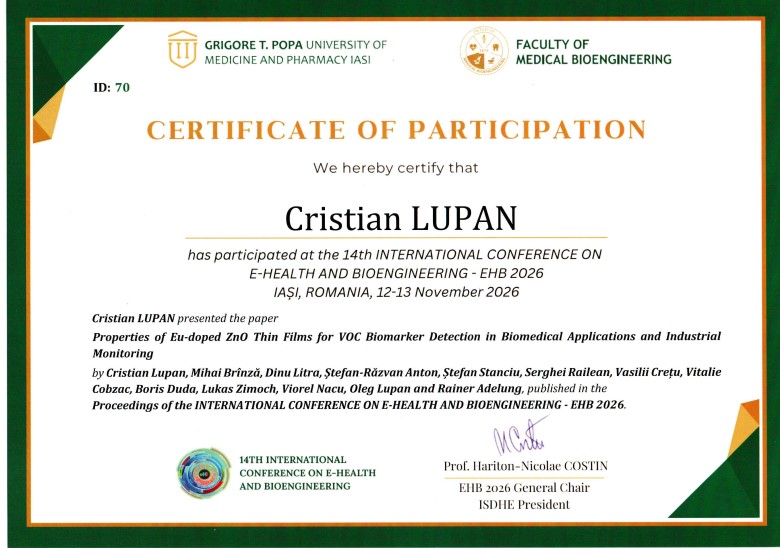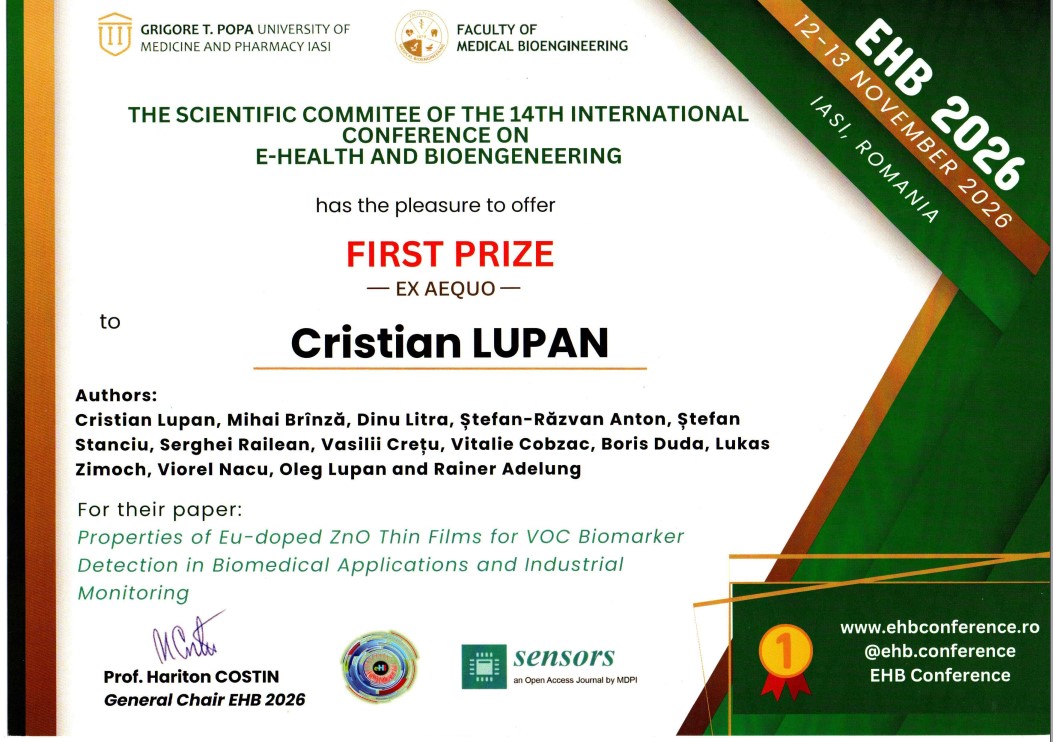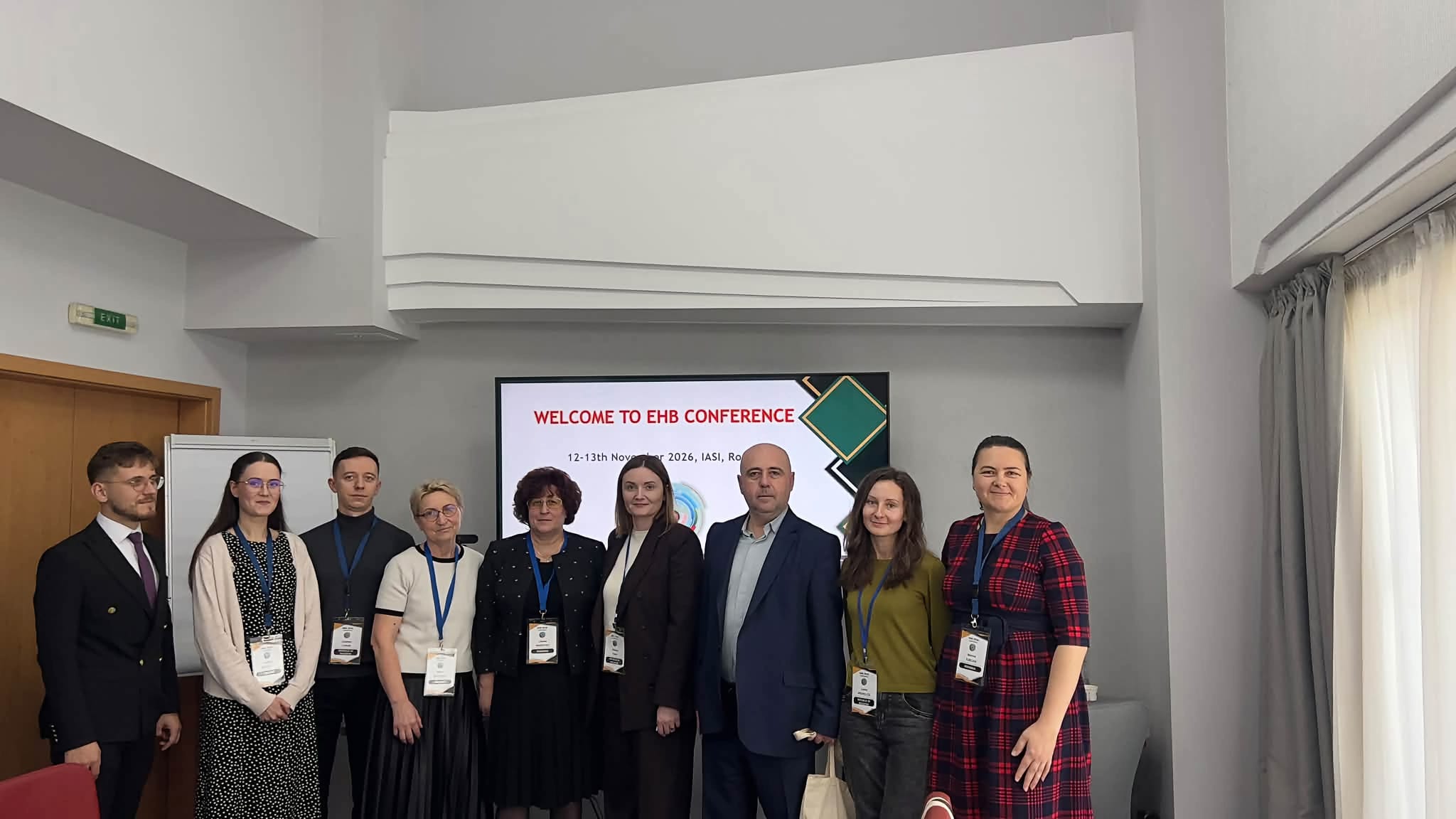
The Faculty of Computers, Informatics, and Microelectronics (FCIM) at the Technical University of Moldova (UTM) has strengthened its visibility within the international scientific community through its achievements at the 14th edition of the International Conference on e-Health and Bioengineering (EHB 2026), held on November 12–13, 2026, in Iași, Romania. A highlight of this participation was the awarding of the 1st Prize (ex aequo) in the EHB 2026 Young Researcher Contest to PhD student Cristian Lupan, for a scientific paper developed within the framework of international research collaborations. The faculty’s participation showcased the scientific work conducted at the Department of Microelectronics and Biomedical Engineering (DMIB) of FCIM, featuring two papers produced by international research teams. These papers addressed the theme of the bilateral project between the Republic of Moldova and Romania, OPTOCARSEMO—”New Approaches to the Optical Characterization of Mixed Semiconductor Oxides Based on Correlative Nanoscale Methods” (PN-IV-PCB-ROMD-2024-0541). The first paper, “Properties of Eu-doped ZnO Thin Films for VOC Biomarker Detection in Biomedical Applications and Industrial Monitoring”—authored by Cristian Lupan, Mihai Brînză, Dinu Litra, Ștefan-Răzvan Anton, Ștefan Stanciu, Serghei Railean, Vasilii Crețu, Vitalie Cobzac, Boris Duda, Lukas Zimoch, Viorel Nacu, Oleg Lupan, and Rainer Adelung—investigates the properties of europium-doped zinc oxide thin films, with a view to their use in detecting volatile organic compounds (VOCs)—including those that serve as biomarkers in biomedical applications—as well as for industrial monitoring.
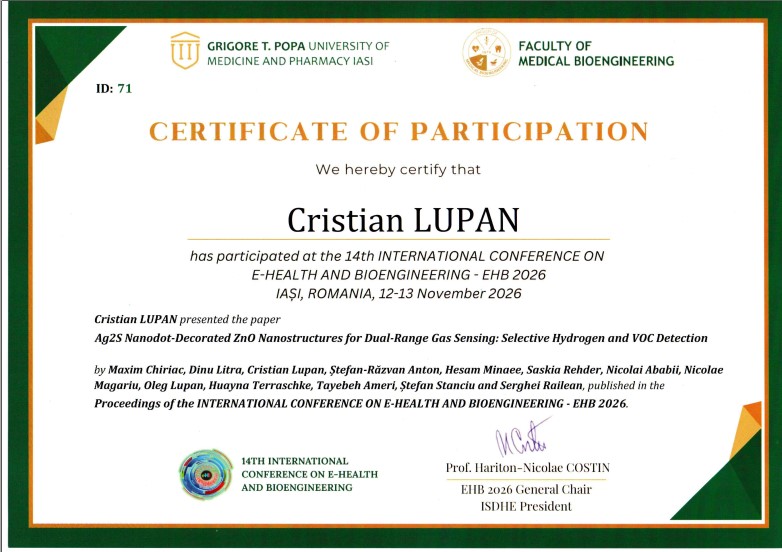
The second paper, “Ag₂S Nanodot-Decorated ZnO Nanostructures for Dual-Range Gas Sensing: Selective Hydrogen and VOC Detection”—developed by Maxim Chiriac, Dinu Litra, Cristian Lupan, Ștefan-Răzvan Anton, Hesam Minaee, Saskia Rehder, Nicolai Ababii, Nicolae Magariu, Oleg Lupan, Huayna Terraschke, Tayebeh Ameri, Ștefan Stanciu, and Serghei Railean—presents research on zinc oxide nanostructures decorated with silver sulfide (Ag₂S) nanodots, aimed at developing sensors for the selective detection of hydrogen and volatile organic compounds. A notable outcome of the participation in EHB 2026 is the First Prize (awarded *ex aequo*) received by PhD student Cristian Lupan in the Young Researcher Contest, for his presentation on the properties of europium-doped ZnO thin films. The distinction, awarded following an evaluation by the conference’s Scientific Committee, highlights the relevance and quality of the research presented, as well as the contribution of young researchers to the development of technological solutions with potential applications in the biomedical and industrial sectors. The research was conducted within the framework of the bilateral project OPTOCARSEMO, implemented in partnership by the Technical University of Moldova and the National University of Science and Technology POLITEHNICA Bucharest, under the coordination of Dr. Ștefan George Stanciu (for Romania) and Assoc. Prof. Dr. Serghei Railean (for the Republic of Moldova). The project aims to develop advanced approaches for investigating semiconductor materials through the use of correlative nanoscale characterization methods, thereby deepening the understanding of their properties and identifying new possibilities for their integration into devices and technological applications.
The team from the Department of Microelectronics and Biomedical Engineering (DMIB–FCIM–UTM) involved in the project’s implementation includes Assoc. Prof. Dr. Serghei Railean (project coordinator for the Republic of Moldova), Assoc. Prof. Dr. Nicolai Ababii, Assistant Lecturer and PhD candidate Maxim Chiriac, and Assistant Lecturer and PhD candidate Dinu Litra. Through their work, the team members contribute to conducting experimental research, developing and characterizing semiconductor materials, investigating their properties, and disseminating the results at international scientific events. The results presented at EHB 2026 also reflect the value of interdisciplinary and international scientific collaboration, bringing together researchers from the Technical University of Moldova, the National University of Science and Technology POLITEHNICA Bucharest, Kiel University (Germany), and the “Nicolae Testemițanu” State University of Medicine and Pharmacy. These partnerships provide significant opportunities for advancing research at the intersection of nanotechnologies, microelectronics, materials science, and biomedical engineering, facilitating the exchange of expertise and the dissemination of findings within the international scientific community.
The Faculty of Computers, Informatics, and Microelectronics extends its sincere congratulations to PhD candidate Cristian Lupan on his achievement, as well as to the OPTOCARSEMO project team and all the researchers involved in developing the work presented. We wish them success in continuing their research activities, as well as new achievements that will contribute to scientific and technological progress!