

“Materials Today Nano” (Elsevier) publishes a new UTM-branded paper
Researchers from the Department of Microelectronics and Biomedical Engineering (DMIB) within the Faculty of Computers, Informatics and Microelectronics (FCIM) of the Technical University of Moldova (UTM) have achieved a new scientific success of international significance – they have recently published a paper in the renowned journal “Materials Today Nano”, edited by the prestigious Elsevier group. This publication is in an elite segment of academic journals, being ranked Q1 in four key areas: condensed matter physics, biomaterials, materials chemistry, and electronic, optical and magnetic materials.
Hydrogen – the energy of the future and the challenges of detection
The paper is the result of a joint effort carried out over 4 years of collaboration between UTM, Christian-Albrechts University of Kiel (Germany), Fraunhofer Institute for Silicon Technology (Germany) and the University of Central Florida (USA). The study focuses on one of the most pressing issues in the use of hydrogen as an alternative energy source: the safety of its detection. Although hydrogen is a promising energy resource, its use comes with major challenges caused by its intrinsic properties – it is colorless, odorless, highly flammable, and difficult to detect.

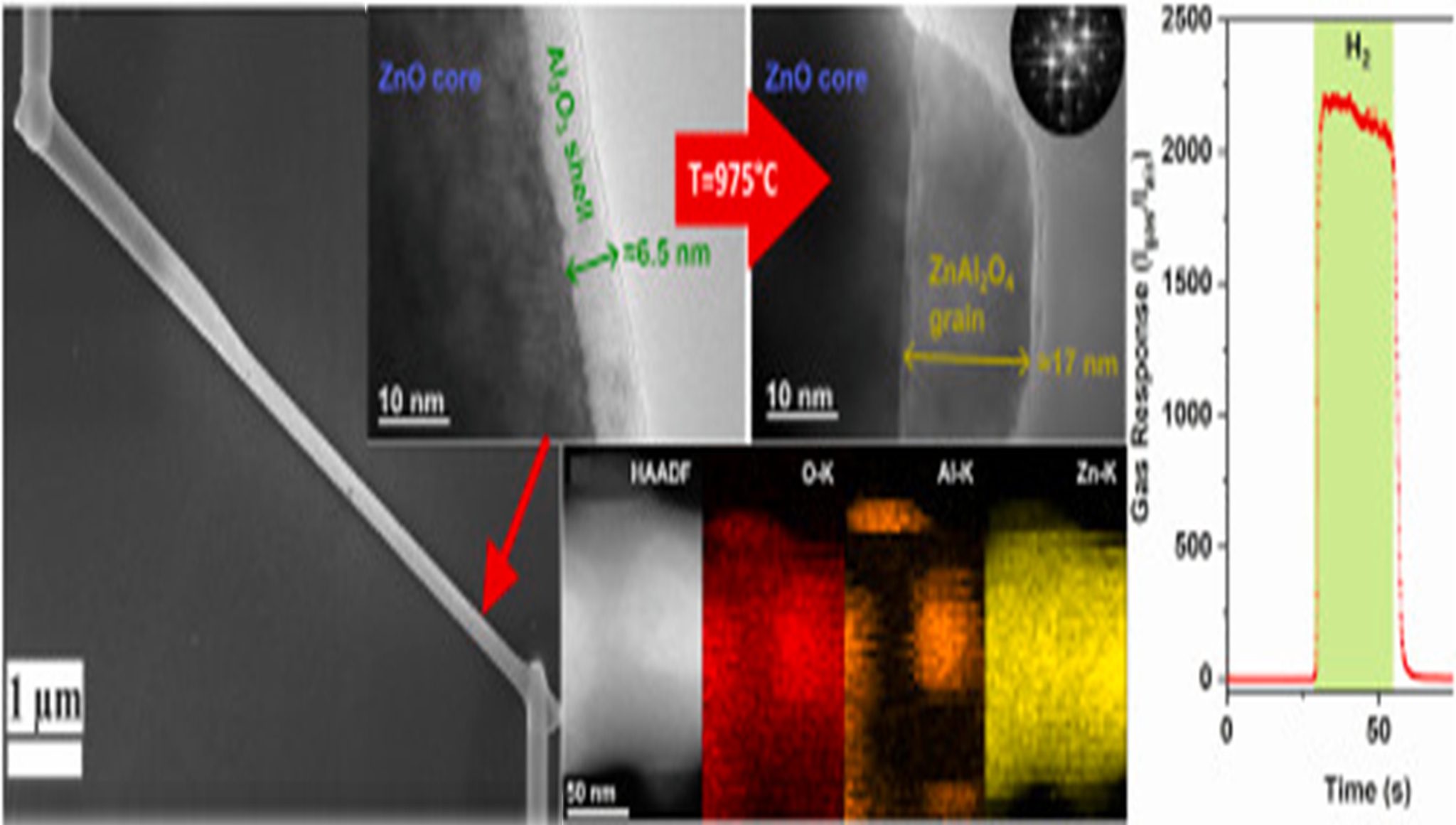
To address this challenge, the research team from the Technical University of Moldova has developed an innovative nanosensor, based on ZnO/Al₂O₃ binary core – ternary shell nanowires, realized through the Kirkendall effect at the nanoscale. This advanced structure allows for extremely fast hydrogen detection, even at low temperatures, with a response time of up to one second and high sensitivity at concentrations as low as 100 ppm.
Nanosensor technology – innovation at the atomic level
The nanowires used in this nanosensor were obtained by flame transport synthesis and atomic layer deposition, followed by a heat treatment at 975°C, which led to the transformation of Al₂O₃ into ZnAl₂O₄. This modification generates an n-n heterostructure that acts as a catalyst, amplifying the sensor signal in the presence of hydrogen. Experimental validation was carried out by advanced techniques such as SEM, TEM, HRTEM and XRD, confirming the structural and functional performances of the device.

The publication of this work in Materials Today Nano provides a special exposure to the scientific community at UTM, being accessible through ScienceDirect to millions of researchers worldwide. This contributes to both increasing the notoriety of the authors and the institution they represent, consolidating UTM’s position in the elite of international research.
The Department of Microelectronics and Biomedical Engineering within FCIM-UTM has an essential role in promoting excellent research and international collaborations. The teaching staff here transfer their experience every day to students from three study programs: “Applied Electronics”, “Microelectronics and Nanotechnologies” and “Biomedical Engineering” from cycles I and II – bachelor’s and master’s degrees, as well as to 5 specialties from cycle 3 – doctorate.
Students passionate about microelectronics and nanotechnologies have the opportunity to actively participate in such revolutionary research within the Center for Nanotechnologies and Nanosensors of UTM. This dynamic academic environment allows them to engage in innovative projects with global impact, thus contributing to the scientific and technological progress of society.
Online references:
https://www.sciencedirect.com/science/article/pii/S2588842025000276
https://ars.els-cdn.com/content/image/1-s2.0-S2588842025000276-mmc1.docx
https://fcim.utm.md/departamentele-fcim/departamentul-mib/
https://www.scopus.com/authid/detail.uri?authorId=10640885800
https://www.scopus.com/authid/detail.uri?authorId=57211992969
The teams involved are affiliated with different research centers:
a Center for Nanotechnology and Nanosensors, Department of Microelectronics and Biomedical Engineering, Technical University of Moldova, 168, Stefan cel Mare Av., MD-2004, Chisinau, Republic of Moldova
b Chair for Synthesis and Real Structure, Department of Materials Science, Faculty of Engineering, Christian-Albrechts Universität zu Kiel, Kiel, Kaiserstraße 2, D-24143 Kiel, Germany
c Chair for Functional Nanomaterials, Department of Materials Science, Faculty of Engineering, Christian-Albrechts Universität zu Kiel, Kiel, Kaiserstraße 2, D-24143 Kiel, Germany
d Fraunhofer Institute for Silicon Technology (ISIT), Itzehoe, Germany
e Chair for Inorganic Functional Materials, Department of Materials Science, Faculty of Engineering, Christian-Albrechts Universität zu Kiel, Kiel, Kaiserstraße 2, D-24143 Kiel, Germany
f Department of Physics, University of Central Florida, Orlando, FL 32816-2385, USA