In the context of the accelerated technological transformations of the 21st century, microelectronics has become one of the strategic fields underpinning the advancement of artificial intelligence, advanced communications, and global digitalization processes. Research in nano-microelectronics contributes directly to the development of emerging technologies and strengthens the competitiveness of knowledge-based economies.
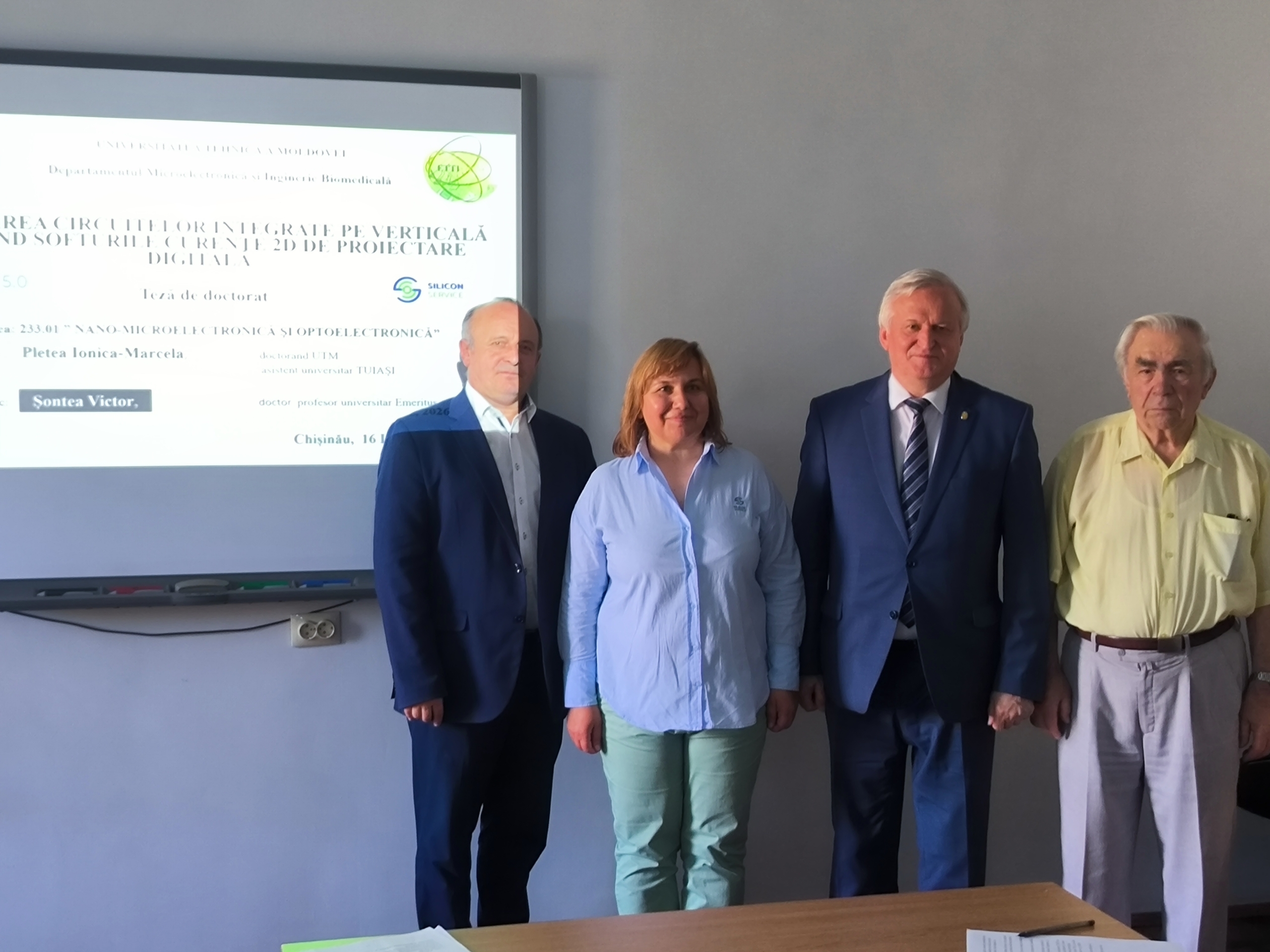
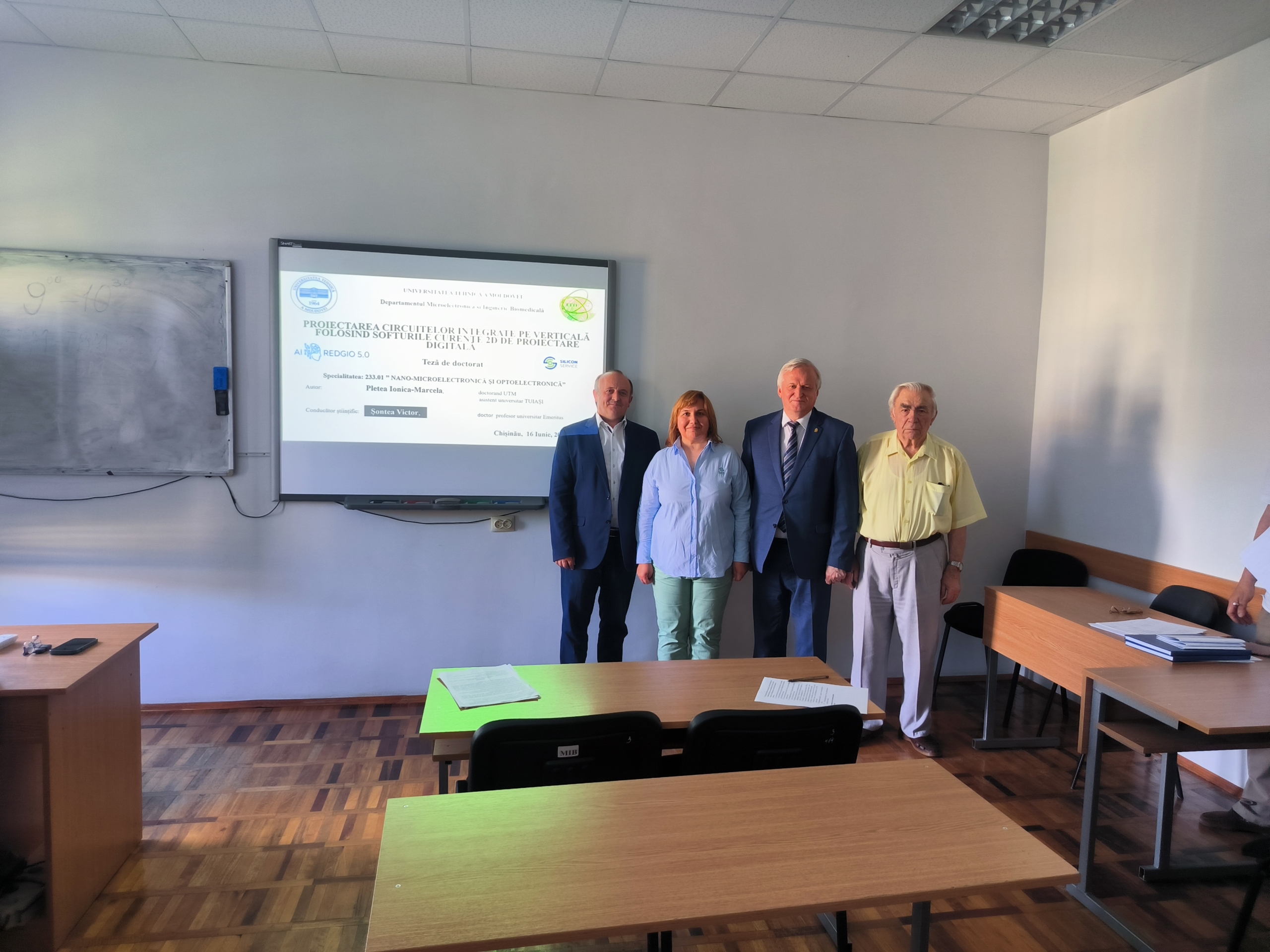
A notable example of high-level scientific achievement is the doctoral thesis entitled “Design of Vertical Integrated Circuits Using Current 2D Digital Design Software Tools”, authored by Ionica-Marcela Pletea, a faculty member at the “Gheorghe Asachi” Technical University of Iași, Romania, and a doctoral candidate at the Doctoral School of the Technical University of Moldova, specializing in 233.01 Nano-Microelectronics and Optoelectronics.
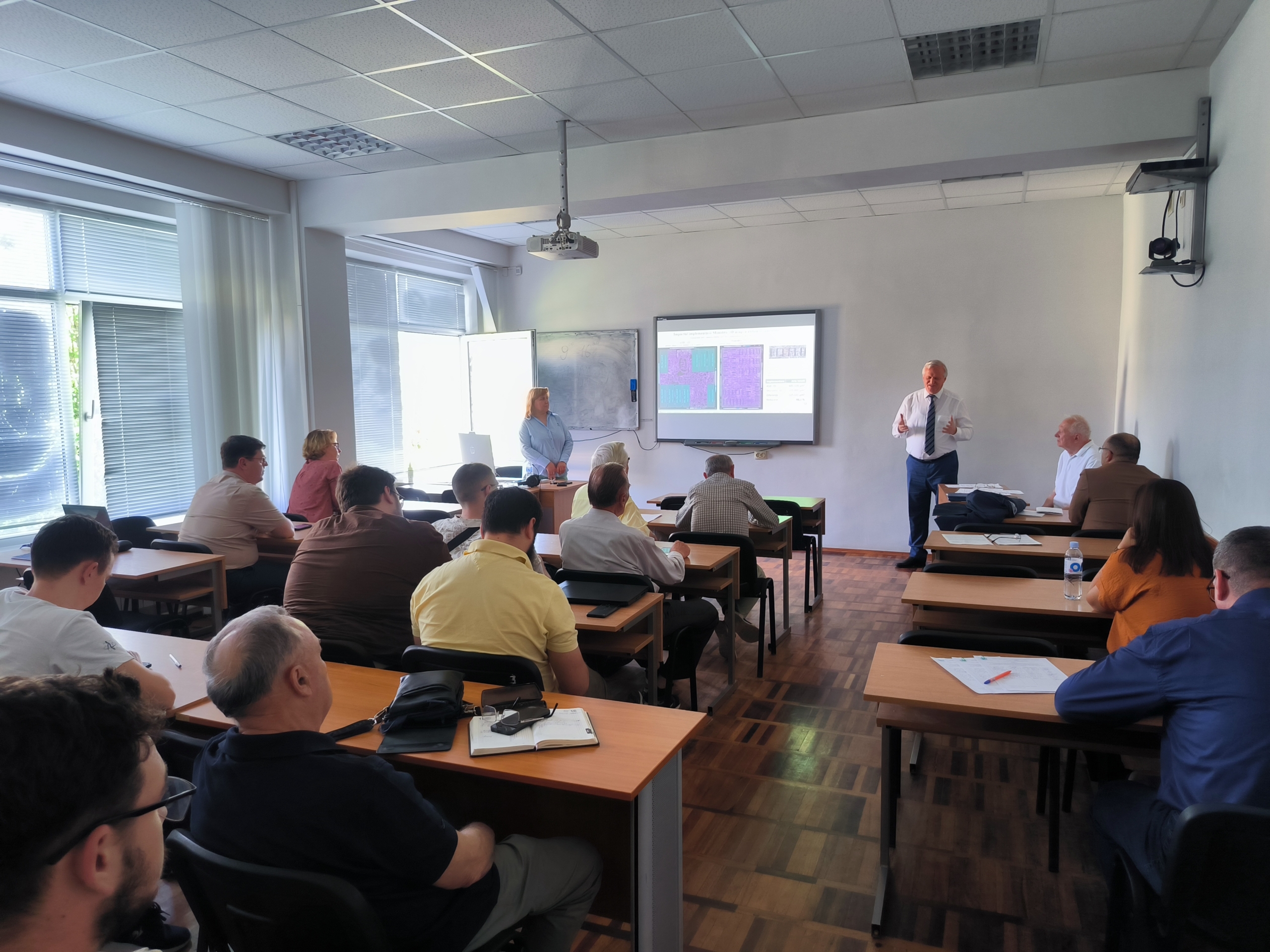
The research was conducted under the scientific supervision of Professor Victor Șontea, PhD, former Dean of the Faculty of Computers, Informatics and Microelectronics, and was evaluated within the specialized Scientific Seminar “Nanotechnologies, New Multifunctional Materials and Electronic Devices.”
The thesis addresses one of the major challenges facing the modern semiconductor industry—the development and implementation of Monolithic 3D (M3D) technology, an innovative approach that enables the integration of electronic functionalities across multiple active layers by exploiting the vertical dimension to enhance performance while reducing energy consumption.
A significant contribution of the research is the development of an original methodology for adapting existing 2D ASIC design tools and workflows to the implementation of three-dimensional integrated circuits. The obtained results demonstrate the feasibility of employing current design infrastructures for the development of future generations of Monolithic 3D integrated circuits, without the need for entirely new and costly software platforms.
The findings confirm the potential of the proposed technology, highlighting a substantial reduction in chip area of up to 46.5%, accompanied by a significant decrease in power consumption. These achievements provide practical solutions for the semiconductor industry and open promising opportunities for the development of hardware accelerators dedicated to Artificial Intelligence applications.
Through its innovative character and practical relevance to the global semiconductor industry, the thesis contributes to strengthening the research activities carried out within the Doctoral School of the Technical University of Moldova and highlights the academic collaboration between the Department of Microelectronics and Biomedical Engineering of FCIM, TUM, and the Department of Applied Electronics and Intelligent Systems within the Faculty of Electronics, Telecommunications and Information Technology of the “Gheorghe Asachi” Technical University of Iași.
The successful evaluation of this doctoral thesis reaffirms the essential role of advanced research in microelectronics for the development of future technologies and for educating a new generation of specialists capable of contributing to scientific and technological progress at the international level.
Congratulations to doctoral candidate Ionica-Marcela Pletea and the supervisory team consisting of Professors Victor Șontea, Oleg Lupan, Ion Tighineanu, and Viorel Trofim for this outstanding academic achievement!