Archive for category: news

Financial intelligence and sustainable development – ​​academic dialogue at FCIM

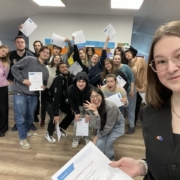
Within the course “Human Security and Sustainable Development,” taught by Daniela Pojar, Vice-Rector for Finance and International Relations at TUM, students of the Faculty of Computers, Informatics and Microelectronics participated in an academic activity featuring a special guest – Andrii Glevatskyi, Vice President of MAIB.

The presentation, entitled “Empowering Growth Through Financial Intelligence,” provided an integrated perspective on the role of financial education in economic and professional development. Structured around several key areas – an overview of MAIB, fundamental concepts of financial literacy, strategic priorities, and case studies – the session highlighted the importance of an informed and responsible approach to managing financial resources.

During the activity, key concepts were addressed, including the pillars of financial literacy (income, spending, saving, borrowing, and investing), its role in achieving personal and professional goals, as well as the importance of informational hygiene in preventing financial risks. At the same time, current trends in the banking sector were presented, with a focus on digitalization, the use of artificial intelligence, and the enhancement of customer experience through innovative financial solutions.

A significant aspect of the presentation was the staged model of financial literacy, illustrated through the process from awareness and decision-making to client growth and retention, emphasizing how financial competencies contribute to the sustainable development of both the business environment and society.

The activity provided students with a practical perspective on the interdependence between human security, economic stability, and financial competencies, contributing to the strengthening of their professional training and the development of critical thinking in relation to contemporary challenges.

The Faculty expresses its appreciation for the valuable contribution to the educational process and for the openness toward academic–practical dialogue.

Excellence at FCIM: The Republican Olympiad in Informatics

The Technical University of Moldova, through FCIM and the ICT Directorate, provided the technical and logistical support for the Republican Olympiad in Informatics. Discover how the collaboration between UTM, the Ministry of Education and Research, and the National Agency for Curriculum and Evaluation created a high-performance framework for 148 young programmers nationwide.

FCIM students discover NLP applications in a lesson held by a guest researcher

Students of the Applied Informatics specialty at the Faculty of Computers, Informatics and Microelectronics (FCIM), Technical University of Moldova, had the opportunity to participate in a lesson on Computational Linguistics held by Ludmila Burțeva, a researcher at the Institute of Mathematics and Informatics “Vladimir Andrunachievici” in Chișinău. During the presentation, current topics in the field of Natural Language Processing (NLP) were addressed, presenting results and research directions from her scientific activity.

One of the topics of interest concerned the digitization of old Romanian texts, including historical documents written in old Cyrillic, a process that involves modern methods of automatic text recognition and processing. The role of synthetic data generation in developing and training artificial intelligence models when real data sets are limited was also highlighted.

The activity was organized under the guidance of Ms. Braniște Rodica, offering students the opportunity to discover practical applications of NLP technologies in text analysis, intelligent systems development and contemporary research in the field of artificial intelligence.

The Applied Computer Science specialty at FCIM places a special emphasis on natural language processing, an essential area of ​​artificial intelligence that allows computer systems to understand, analyze and generate human language. NLP technologies are the basis of modern digital tools widely used for machine translation, intelligent search, voice interaction with computer systems, sentiment analysis or chatbot development.

By studying these technologies, students acquire relevant skills in textual data analysis, language modeling and application development based on artificial intelligence, skills that are increasingly in demand in fields such as IT, fintech, digital media, education and research.

We thank Ms. Ludmila Burțeva for her captivating presentation and for sharing her research experience with our students. Such activities contribute to strengthening the connection between academia and scientific research, stimulating interest in emerging areas of computer science.

Beyond borders, closer to oneself: Erasmus+ mobility of student Liviu Mereacre in Estonia

For Liviu Mereacre, a student of the Faculty of Computer, Informatics and Microelectronics, the “Information Security” study program, the Erasmus+ academic mobility in Estonia meant much more than a simple study internship. It was a transformative experience, a journey of self-discovery, of overcoming limits and of building a new perspective on the world and on his own career.

The mobility internship at Tallinn University of Technology harmoniously combined academic rigor with the freedom of cultural exploration and the challenges of personal development. The Estonian university environment, oriented towards autonomy, innovation and critical thinking, led Liviu to fully exploit his potential. Among the notable academic achievements is the development of his first programming language – an important step in his professional maturation and a proof of the skills consolidated during the mobility.

erasmus logo nou 1 - Dincolo de granițe, mai aproape de sine: mobilitatea Erasmus+ a studentului Liviu Mereacre în Estonia

Beyond the classroom, the Erasmus+ experience was a true cultural immersion. Liviu discovered authentic Estonia – from traditional markets and concerts by local artists, to celebrating New Year’s Eve in Tallinn’s Freedom Square, alongside people from all over the world. His desire to explore also took him to other corners of Northern Europe, where he visited symbolic places such as the Hill of Crosses in Lithuania or the Republic of Užupis, each with its own story, identity and energy.

The highlight of the mobility was, without a doubt, the trip to Lapland (Sápmi) – an almost surreal experience. Here, Liviu saw the Northern Lights for the first time, a natural spectacle that gave him a lesson in humility and admiration for nature. The Arctic adventures continued with visits to Santa Claus Village, snowmobile rides to the border of the three countries, ice fishing and the experience of a traditional sauna near the fjords. All of this deeply connected him to nature and redefined his perception of extremes and their beauty.

Equally valuable was the social dimension of mobility. The activities carried out alongside international students – karaoke nights, pub crawls, board games and late-night discussions about cultures, values ​​and dreams – contributed to the development of communication skills, adaptability and intercultural openness. Each meeting became a lesson in diversity and a bridge between different worlds.

Liviu Mereacre believes that the Erasmus+ mobility in Estonia gave him not only academic knowledge, but also the courage to explore the unknown, confidence in his own strengths and a broader perspective on life. It is an experience that shapes characters, opens horizons and creates memories that last forever. With enthusiasm and conviction, Liviu encourages every student to take advantage of this unique opportunity – because Erasmus+ is not just about studying abroad, but about personal and professional development in a world without borders.

FCIM students promoted online safety among students from the “Ion Luca Caragiale” Gymnasium

On Internet Safety Day, an educational activity dedicated to primary school students was held at the “Ion Luca Caragiale” Gymnasium in the municipality of Chisinau, focused on developing responsible online behavior.
The activity was supported by students of the Information Security study program within the Faculty of Computers, Informatics and Microelectronics (FCIM).
Adrian Angheluș, a graduate of the “Ion Luca Caragiale” Gymnasium, returned to the institution where he studied, this time as a student, together with his colleagues Buza Alin and Cristioglo Alexandru (SI-253 group).
They discussed with the students simple but important rules for internet safety, such as protecting personal data, responsible communication in the online environment, avoiding interactions with unknown people and the importance of asking for help from an adult when unclear situations arise.
To make the messages easier to understand, the students also presented the educational cybersecurity game “Spoofy”, through which children can learn, in an interactive way, how to recognize risks in the digital environment. The game is used as an educational tool in promoting cyber hygiene, and among the collaborators involved in its promotion is UTM Cybercor.
The activity was carried out with the support of the head of the Information Security study program, Astafi Valentina, and the deputy head of the Department of Software and Automation Engineering, Cojocaru Svetlana, who constantly supports digital education initiatives and collaboration with pre-university education institutions.
Such meetings contribute not only to informing students, but also to forming a culture of online safety from an early age, and the involvement of students in such activities shows the important role of the academic community in the digital education of society.

Primary examination of the doctoral thesis of PhD student Rajat Nagpal

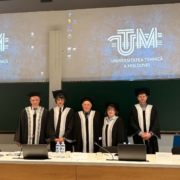
On January 26, 2026, during the Meeting No. 5 of the Department of Microelectronics and Biomedical Engineering (DMIB) of the Faculty of Computers, Informatics and Microelectronics (FCIM), Technical University of Moldova, the primary examination of the doctoral thesis (joint PhD) of the doctoral student NAGPAL Rajat, specialty 134.03 – Physics of Nanosystems and Nanotechnologies took place.

The thesis, titled: “Porous Networks of Nanostructured Hybrid Materials”, was carried out within the framework of a joint doctorate (joint doctorate) between the Technical University of Moldova and the University of Kiel (Germany), for the award of the titles of Doctor of Physical Sciences and Doctor of Engineering.

Scientific leadership:

  • prof. univ., dr. hab. Oleg LUPAN – Technical University of Moldova
  • prof. univ., dr. Rainer ADELUNG – University of Kiel

Supervisors:

  • prof. univ., dr. hab. Artur Buzdugan
  • assoc. univ., dr. Nicolai Ababii
  • assoc. univ., dr. Vasile Crețu

The doctoral thesis addresses the development and characterization of nanostructured hybrid structures based on MOFs (ZIFs) and metal oxides, with applications in the selective detection of hydrogen and volatile organic compounds, including under adverse environmental conditions. The results obtained demonstrate relevant structure–properties–performance correlations and a high application potential in the field of gas sensors.

Scientific results:

  • 23 scientific publications, of which 14 SCOPUS indexed, including 12 ISI
  •  1 patent
  •  40 SCOPUS citations, H-index: 4

Following the presentation and scientific discussions, the thesis was positively assessed, and the doctoral student successfully passed the primary examination stage, being recommended for the next stage – the Profile Scientific Seminar.

Congratulations to doctoral student Rajat Nagpal for successfully passing the primary examination stage of his doctoral thesis!
We wish him continued success in his academic and professional career, as well as remarkable achievements in research and innovation.

A new class of master’s degree graduates at the Department of Software Engineering and Automation

During January 19–28, 2026, at the Department of Software Engineering and Automation, Faculty of Computers, Informatics and Microelectronics, Technical University of Moldova, public defenses of master’s theses for the Information Security, Software Engineering and Information Technology study programs took place.
In the Information Security program, 15 students defended their papers before the evaluation committee, coordinated by Țușca Andrei, Head of IT Security and Business Continuity Service at BC MAIB SA. The topics addressed concerned organizational information security, cyber risk management, data protection and ensuring operational continuity.
For the Software Engineering program, the defenses brought together 18 students, the papers being evaluated by the committee led by Oașerele Olesea, Portfolio Director at Amadaris SRL. The theses reflected current concerns in the field of software engineering, including application design and architecture, information systems development and software quality assurance.
The Information Technology program registered the participation of 27 students, the presentations being evaluated by the committee coordinated by Caterenciuc Artiom, an expert in information and communications technology, senior category, within M-Testing SRL. The topic of the papers highlighted the interdisciplinary nature of the program, focused on applied computer solutions, information systems and modern digital technologies.
The management of the CIM faculty and the staff of the ISA Department would like to thank all members and chairmen of the evaluation committees for the professionalism, expertise and openness shown in the evaluation process, contributing to ensuring the quality of the academic act.
Sincere congratulations to the graduating students for the effort made and for the level of preparation demonstrated during the public presentations. Completing the master’s degree represents an important step in the professional path and opens up new development opportunities in the field of information technologies.


Completion of Master’s studies: a new class of graduates of the “Computers and Information Networks” program

During January 26-27, 2026, at the Department of Informatics and Systems Engineering, the public defense of the master’s theses for the “Computers and Information Networks” study program was held.

The event represented the final stage of the master’s training, offering graduates the opportunity to capitalize on the results of their research and development activities carried out during their studies. The defenses took place in public, in front of the Master’s Commission formed by the teaching staff, associate professor, Dr. Sudacevschi Viorica, associate professor, Dr. Ababii Victor, associate professor, Dr. Moraru Victor and lecturer, Dr. Cărbune Viorel and the President of the Commission Pantaz Gheorghe, founder of SmartGov LLC and consultant in the field of Digital Government.

The 19 graduate students presented their papers in which they described the objectives pursued, the methodologies applied, the proposed solutions and the results obtained. The presentations were followed by question sessions, which allowed the assessment of the level of scientific argumentation, technical correctness and applicability of the implemented solutions.

The topic of the theses reflected the current trends in the IT field and the orientation of the Computers and Information Networks program towards advanced technologies and applications with real impact. A special interest was given to cybersecurity, addressing topics regarding the detection of malicious activities in information networks and the prevention of DoS/DDoS attacks in connected infrastructures. At the same time, papers focused on digital transformation and Cloud-Ready systems were presented, as well as solutions for concurrent processing and specialized hardware implementations. An important segment of the papers targeted artificial intelligence, through solutions for automatic data analysis and classification, model optimization through modern algorithms and the use of visual recognition techniques.

Also, topics dedicated to the Internet of Things (IoT) and e-Health were highlighted, through the development of platforms and devices for remote monitoring of vital parameters, the design of IoT networks with increased robustness, as well as projects with a social dimension, oriented towards assistive technologies and digital inclusion.

The master’s examination committee appreciated the quality of the theses and the level of the solutions presented, which confirms the relevance of the program and the very good preparation of the graduates of the master’s program Computers and Information Networks.


XMAS FAF Hackathon 2025: when code resonates with the magic of the holidays

On the eve of Christmas, XMAS FAF Hackathon 2025 compiled code with the magic of the holidays, transforming into a vibrant hub of ideas and pure energy.

During December 20-21, as the city prepared for carols, the future was being written at Tekwill. XMAS FAF Hackathon 2025 exceeded the limits of a simple programming contest, becoming a space where the spirit of Christmas perfectly synchronized with innovation, competition and limitless creativity. There were two intense days of coding, two nights of hacking, dozens of teams and a single common vibe: Build something epic.

Rightly declared the most epic event of the end of the year, this hackathon was a 360° experience: about cool people, brave ideas, inspirational mentors and projects that came to life under the pressure of time and ambition.

Why you had to be there? Because XMAS FAF is not just about lines of code, but also: People first – networking with people who challenge and inspire you; Level up your skills – getting out of your comfort zone to build solutions you can be proud of; Top mentorship – access to industry brains, ready to turn your ideas into real-world solutions; Portfolio boost – battle-tested projects, that clearly say: I know what I’m doing; Festive chaos – holiday vibes, exclusive swag, pizza, coffee and lots of FAF hype. Because End 2025 in style is not about a simple “Happy New Year!”, but about a build, a victory and a memorable memory.

Challenges – the battleground of creativity

The hackathon launched serious challenges, designed to force that out-of-the-box thinking essential in tech:

ELSE Challenge (powered by UTM) – a true endurance test for analytical minds, where logic, critical thinking and elegant solutions made the difference;
Smart Home Sentinel Challenge (powered by Allied Testing) – home security reimagined through smart code, with a focus on reliability and real-world applications;
Architecture Challenge (powered by Stefanini) – building complex and scalable systems, where the big picture was the key to success.
Here, it wasn’t just about coding fast, but thinking smart.

Mentors – the backbone of the experience

The mentors’ lineup brought together university professors, AI Engineers, cybersecurity experts and product managers. They were the ones who asked the tough questions, provided authentic industry feedback and brought that extra spark in critical debugging moments. With such support, ideas quickly left the sketch stage, becoming functional prototypes.

The two days of the competition meant a continuous flow of ideas, without breaks for inspiration, as participants were involved in an intense marathon of coding, collaboration and creativity.

Timeline of an epic weekend

Day 1: Start, Team Formation & Non-stop Hacking. It all started with an electrifying energy. After the team formation, the Tekwill space turned into a brainstorming hive. A special moment was the Stefanini Quiz, a well-deserved break from screens, but full of adrenaline. The prizes – LEGO sets – were the perfect symbol: in tech, as in LEGO construction, you need logic, patience and vision. The evening quickly turned into night, and the night — into a legendary session of uninterrupted hacking.

Day 2: Pitching & The Moment of Truth. The focus shifted to delivery. The last adjustments and moments of constructive “panic” culminated in the morning with the final presentations. The teams demonstrated not only technical skills, but also remarkable clarity in pitching, transforming complex solutions into coherent and impactful speeches.

Partners that fueled the experience

An epic hackathon needs a worthy “engine”, and the FAF community was supported by partners who believe in people and innovation:

Stefanini Institute EMEA (General Sponsor) – the company that proves that innovation starts with people;

Planet Group International and Allied Testing-Moldova (Premium Sponsors) – supporters of technological excellence and software quality;
Technical University of Moldova, Cybercor and Efes Moldova (Official Partners): – pillars of education, digital security and community spirit.

Hall of Fame – 2025 edition winners

After 48 intense hours of hacking, the following took the podium:

  • ELSE Challenge – Team 9 (Andi BLÂNDU, Mihai CARAMAN, Daniela COJOCARI, Cătălin DÂRZU, Janeta GRIGORAȘ),
  • Smart Home Sentinel – Team 6 (Mihai VIERU, Vlad POLIȘCIUC, Andrei CLIUCOVSCHI, Dmitrii BELIH, Daniel CANTER),
  • Architecture Challenge – Team 3 (Igor TACU, Loredana TACU, Ina PANCENCO, Valeria POSTICA, Nichita RUSNAC).

Mentoring and festive vibes

Success doesn’t just come from lines of code, it also comes from the right guidance. The 19 mentors (from AI Engineers to Senior Devs from companies like Orange Systems, Grid Dynamics or Amdaris) were with the participants throughout the event, transforming challenges into lessons and ideas into concrete solutions.

With FAF swag, infectious energy and memories that will last a long time, XMAS FAF Hackathon 2025 proved once again that this community doesn’t just write code, it builds experiences.

FCIM student at the Moldova Eco Energetica 2025 Gala

FCIM express their deep appreciation for the remarkable participation of  Plămădeală Daniela, from the Data Science study program, at the Moldova Eco-Energy Gala 2025. The event, held on Friday, December 5, 2025, at Digital Park, brought together key actors from the national clean technology ecosystem, providing a favorable platform for dialogue, collaboration, and the advancement of the green transition in the Republic of Moldova.

Plămădeală Daniela had the honor of being invited and awarded in the category “Policies, Education, and Models of Sustainable Development” for her work entitled “Modeling Electric Mobility Trends in the Transition Toward Sustainable Transport,” a study that also forms the foundation of her bachelor’s thesis. The distinction highlights not only the scientific merit of her research but also the relevance of the topic in the context of major transformations within the national energy and mobility sectors.

The celebratory moment was further enriched by congratulatory messages from representatives of various embassies and from the Minister of Energy, Mr. Junchietu, who emphasized the importance of involving young researchers in promoting sustainability-oriented innovations.

The Gala was organized by the National Center for Sustainable Energy and the GCIP Moldova project (UNIDO, GEF), with institutional support from the Ministry of Energy and in partnership with several distinguished national and international actors, including the European Union, the Government of Germany, UNDP Moldova, the Government of Denmark, AFD Group, the Government of Switzerland, Skat Consulting, Premier Energy, and MAIB.

We are grateful and proud of the achievements of our student, Plămădeală Daniela, viewing this distinction as a confirmation of the academic excellence fostered within the Data Science study program and of the institution’s commitment to supporting initiatives dedicated to sustainable development.